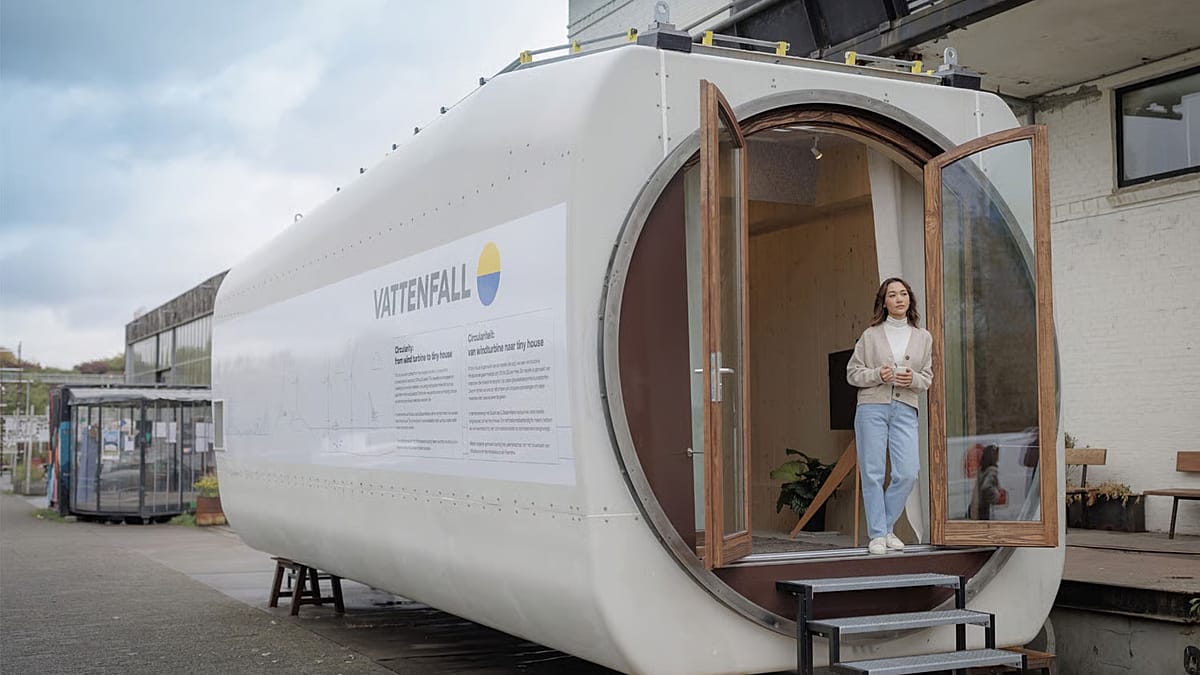
What happens to decommissioned wind turbines and blades? Some are finding new life as buildings.
Europe is on track for a record wind year, with 8.8 GW of new capacity installed in the first half of 2026 – a 30 per cent jump year on year.
That’s enough electricity to power around seven million European households and replace fossil fuel imports equivalent to 25 LNG tankers a year, according to industry nonprofit WindEurope.
But every turbine that goes up eventually means one coming down – and manufacturers are still working out how to make sure none of the materials go to waste.
I’m a big fan of this idea.

Haha!
I’m a big fan of big fans too!
Welcome to the fan fan club!
Fan fans are fanning out to fan fan, and fandom in general, fanaticism.
This needs to say tiny SECOND homes. These are temporary vacation toys for the wealthy, not primary dwellings for anyone.
Between gentrification, the takeover of thrift stores and things like this - we can’t even repurpose garbage to benefit the less fortunate. Everything is an “endless record profits” engine.
This sounds like cargo container housing all over again.
You make it sound like container housing was a fad. Container housing is on the rise.
I thought about container housing at one point because I thought it was cool but when you actually start to get into it it’s really not actually very good. Most of the time you need a new container you can’t use containers I had stuff in them previously because you don’t know what was in them and they could be biohazard. Or just really chemical hazard. It turns into a hole to do that’s not worth it environmentally.
The problem in most places is not the type of house, but getting somewhere to actually build the housing. In the UK any potential site is bought by big developers who put as many houses as possible in a small space to maximise profits
Could you stick one in the garden and just live in it as another bedroom? Or partially bury it and pile the earth up on top of it so you have a hobbit hole.
Would love to try something like that but my garden is a bit small.
I want to live in an Earth bermed shipping container more than I want a lot of things.
Isn’t that the point of a tiny home? That you can have a lot of them in a given space?
It’s so absurd; it’s more expensive to convert a container into a home than to just build the home on site
Really? Do you have actual info on this?
The structural rigidity of an ISO shipping container comes from the corrugated walls; that’s how you can stack them. The walls have to be continuous for that to work. Once you start cutting holes in the walls to have windows and doors, you need to retrofit a stiffening frame or the container isn’t rigid enough. You need framing anyway in order to insulate and finish the interior walls.
But if you’re just going to put up a frame anyway, you may as well timber-frame a similar sized structure. You’re not getting anything from the container except a roof and two doors you won’t use, and it’s pretty cheap to roof a small structure too. Plus a lot of “container homes” wind up roofing the container anyway, since the used ones tend to have leaks.
It’s be cheaper to traditionally frame a same-sized structure and just make it look like a shipping container.
But they’re at least much larger and better built - all the “new” containers you can buy in the use are built as one trip containers in China - sure they seem in good condition, but their longevity is suspect.
Steel is a stupid and wasteful application to make housing.
Glamping, maybe. Clearly not houses.
Four metres wide, 10 metres long and three metres high,
this one is larger (by about 25%, and excluding the also higher ceiling) than my walk-up apartment.
It’s a touch larger than my apartment, too, and with no upstairs neighbors…
Larger than my apartment as well. My place is an ADU (additional dwelling unit). It was previously a garage.
A nice, long house like that is begging to be turned into a passive-solar house.
This is about the same size as the liveable area of my house. Slightly larger, I think.
I’d rather have had that when I was living out of my car.
Perfect for housing the homeless. Better than no home.
There seems to be a big market for tiny homes among older single people especially women. Like containers, there should be no problem in linking a couple or pods to create a bigger space.
An interesting guest house if nothing else though if want to set up plumbing
It’s the perfect guest house. Separate from the main house and not comfortable for long term visits.
I lived semi-comfortably for over a year in a 29m² apartament with my spouse and our small child. I see no reason why 40m² couldn’t be a permanent solution for singles and child-free couples. Depending on structural durability (can they be stacked? Maybe if we add a steel frame?) we could build apartament complexes which would further extend the user pool. You don’t need a lot of space inside the house if you have a well stocked library and community workshop around the corner. Add some playgrounds and you can house young families. Heck, join two modules together and you got space enough for a 2+2 family for a lifetime.
The only real problems I see is we don’t know the energy efficiency of the unit and how the cost compares to traditional building methods. If it isn’t much cheaper the downsides (fixed size, lack of steady supply etc.) will kill it.
60m² and our house was originally 3 bedrooms. High ceiling also means you can store stuff vertically more, get some tall shelves.
Fiberglassmping?
I’d get motion sick.
Nice 360° view though.
Cool, but why can’t the housings be reused for replacement turbines?
By the time one of these housings is getting phased out, the turbine design is years or decades out of date. The internal components are all going to be different. The exterior of the housing is also part of the airflow design.
Considering the amount of torque being applied to the components in the housing by the rotor, it probably wouldn’t be safe to drill new mounting holes in an old housing to fit a new generator &etc.
The blades aren’t worth much, you can probably just shred it and turn it into fiberglass insulation.
fiberglass insulation works because of 2 things, glass’ low thermal conductivity, but especially because all the air trapped between all the thin strands. Shredding these would create a mainly compact granulate/dust, and a shit ton of microplastics.
Yeah fiberglass insulation is loose strands. Fiberglass as a building material is woven into fabric, then rigidized with epoxy. You can’t turn it back into strands.
Yeah, you would probably have to reprocess it or use it as a some lower quality filler.
Nakagin Capsule Tower, thou art avenged
Get George Clarke to do one of these