

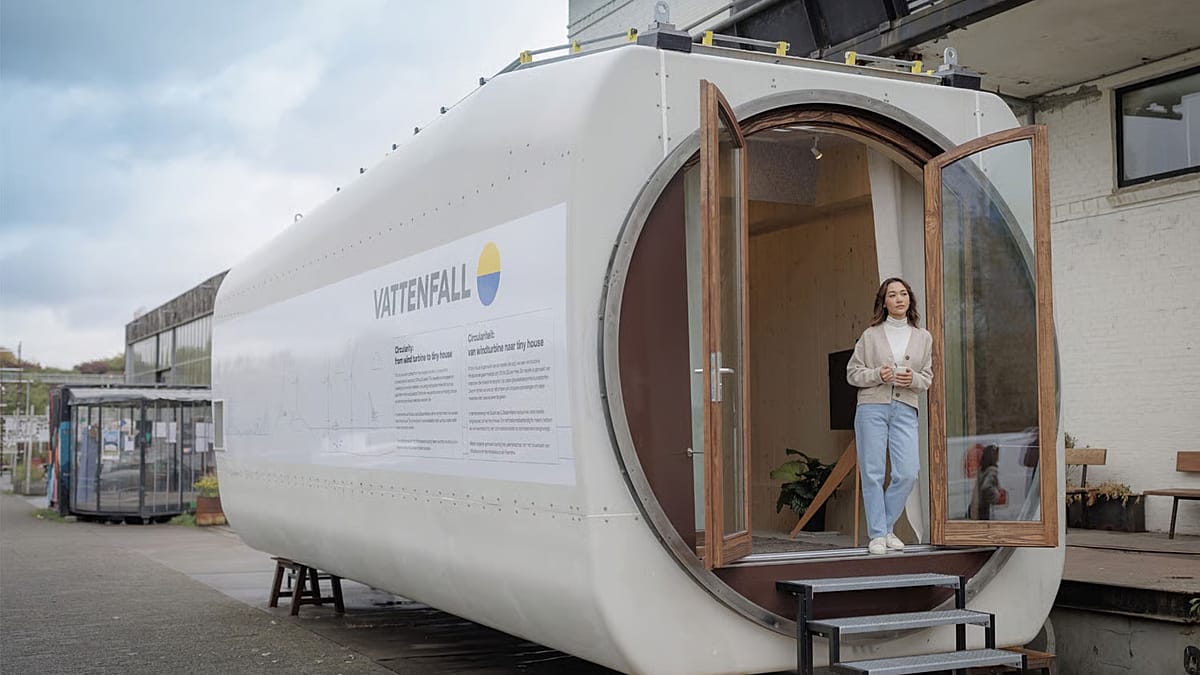
What happens to decommissioned wind turbines and blades? Some are finding new life as buildings.
Europe is on track for a record wind year, with 8.8 GW of new capacity installed in the first half of 2026 – a 30 per cent jump year on year.
That’s enough electricity to power around seven million European households and replace fossil fuel imports equivalent to 25 LNG tankers a year, according to industry nonprofit WindEurope.
But every turbine that goes up eventually means one coming down – and manufacturers are still working out how to make sure none of the materials go to waste.
Really? Do you have actual info on this?
The structural rigidity of an ISO shipping container comes from the corrugated walls; that’s how you can stack them. The walls have to be continuous for that to work. Once you start cutting holes in the walls to have windows and doors, you need to retrofit a stiffening frame or the container isn’t rigid enough. You need framing anyway in order to insulate and finish the interior walls.
But if you’re just going to put up a frame anyway, you may as well timber-frame a similar sized structure. You’re not getting anything from the container except a roof and two doors you won’t use, and it’s pretty cheap to roof a small structure too. Plus a lot of “container homes” wind up roofing the container anyway, since the used ones tend to have leaks.
It’s be cheaper to traditionally frame a same-sized structure and just make it look like a shipping container.