

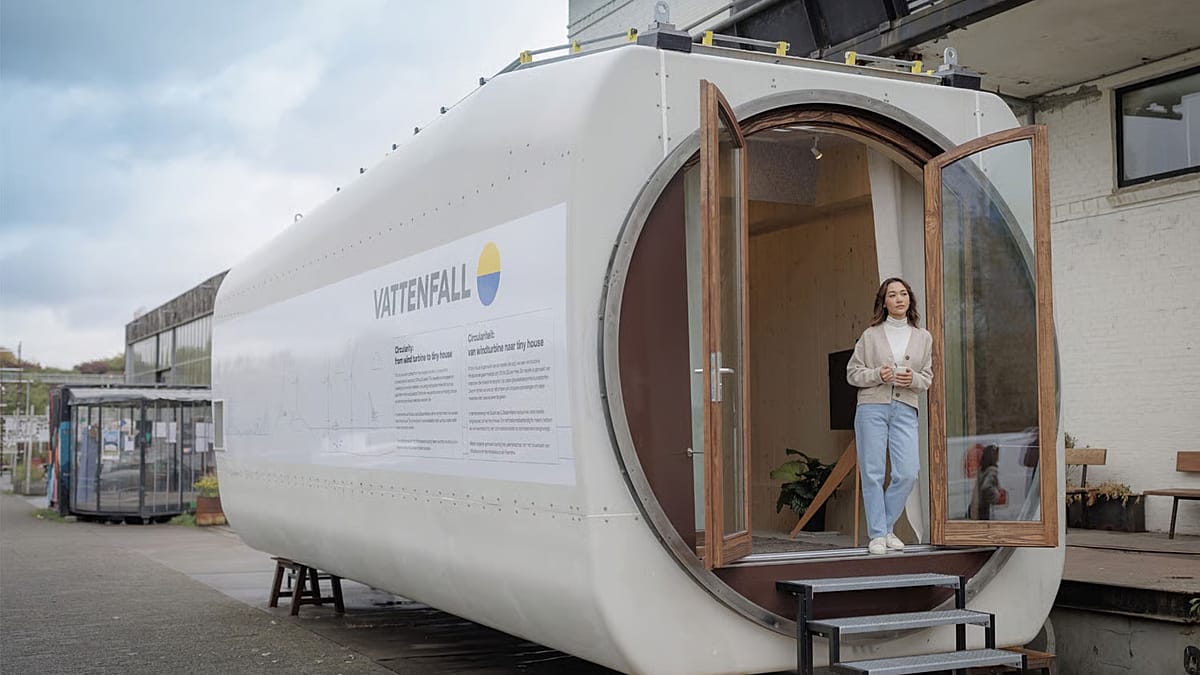
What happens to decommissioned wind turbines and blades? Some are finding new life as buildings.
Europe is on track for a record wind year, with 8.8 GW of new capacity installed in the first half of 2026 – a 30 per cent jump year on year.
That’s enough electricity to power around seven million European households and replace fossil fuel imports equivalent to 25 LNG tankers a year, according to industry nonprofit WindEurope.
But every turbine that goes up eventually means one coming down – and manufacturers are still working out how to make sure none of the materials go to waste.
I lived semi-comfortably for over a year in a 29m² apartament with my spouse and our small child. I see no reason why 40m² couldn’t be a permanent solution for singles and child-free couples. Depending on structural durability (can they be stacked? Maybe if we add a steel frame?) we could build apartament complexes which would further extend the user pool. You don’t need a lot of space inside the house if you have a well stocked library and community workshop around the corner. Add some playgrounds and you can house young families. Heck, join two modules together and you got space enough for a 2+2 family for a lifetime.
The only real problems I see is we don’t know the energy efficiency of the unit and how the cost compares to traditional building methods. If it isn’t much cheaper the downsides (fixed size, lack of steady supply etc.) will kill it.
60m² and our house was originally 3 bedrooms. High ceiling also means you can store stuff vertically more, get some tall shelves.