That’s the thing. Corporations report their own deductions, but individuals have to follow existing law, when there’s a high variance among necessary spending
You can also report your own deductions if you itemize. If your income is low, the standard deduction is probably just significantly bigger than your itemized deductions.
You definitely want to be operating some sort of home business on the side, even if you are employed. You don’t get to count employment-related expenses, but you do get to count expenses attributable to that separate business.
Also, not true. You can deduct any expense needed for work. Uniform, supplies, food if you’re required to eat on the clock, car payments if you’re a delivery driver, all deductible. You can deduct a haircut if your employer has a grooming policy.
It’s just not worth it for most people. You need to save receipts and be able to prove it was a job-related expense, and if you do something wrong, you could be charged with tax fraud.
Commuting to and from the job is an expense needed for work. You can claim that part of your non-reimbursed travel expenses to temporary work sites that exceed your normal commute, but you can’t claim your normal commute.
You cannot deduct your commuting expenses. Not gas. Not bus fare. Not parking.
Uniform items are deductible only of you don’t get a uniform allowance.
If they give you a $50/yr boot allowance, you don’t get to claim your $300 Red Wings. If you buy your own tools but your employer provides a (shitty, shared) set, you don’t get to deduct your tools.
But, this is all about W2 employment. In practice, the overwhelming majority of expenses you incur in the process of W2 employment are not actually deductible, because your employer is already taking the deduction.
But, if you are running your own home business, your usual workplace is your home, and you can claim transportation expenses anywhere you need to go for that business. You can deduct the use of a part of your home. You can deduct part of your utilities, your wardrobe, your tools. Even if your home business is one of the 30% that are operated at a loss, you can deduct the expenses incurred while doing business, and offset a part of your W2 income.
Even that though, you can only deduct part of your living expenses. There is no food deduction afaik, there is no deduction for insurance as far as I know.
No, that’s incorrect. I am very well aware of this. Businesses only have to pay sales taxes on purchases for which they are the end user. They’ll pay sales taxes on their office supplies and services provided to the business. But manufacturers do not have to pay sales taxes on the raw materials they purchase. Retailers do not pay sales taxes on wholesale purchases they make for resale. Only the end-user pays the sales tax on a purchase.
I work with a couple vendors that do not collect sales tax at all. They only sell B2B, and they only sell to businesses who provide them with a sales tax exemption certificate.
What you are describing is more akin to Europe’s VAT system. Still, under VAT, everyone in the chain pays VAT, and each vendor remits the collected VAT to the tax authority. But, the business-buyer reclaims that VAT from the tax authority if they are not the end-user of the purchased product. Everyone but the end user can reclaim their VAT payment.
Which is ass backwards. Audit those with the highest amounts and they made way more money. It’s proven it worked that way until they cut funding for it
I’m pretty sure I read that auditing the wealthy is a huge profit center for the IRS, because they find people who aren’t paying what’s owed. Naturally conservatives (of any party) hate this and gut it whenever possible
Auditing in general is profitable, but it’s mostly due to it being automated for people that aren’t making 7 figures. Auditing the not absurdly wealthy is also generally a positive revenue. Auditing the extremely wealthy tends to not be a great net benefit as the costs of lawyers and court time outweighs the settlement check at the end. There’s an argument to be made it’s worth the cost to ensure the ultra wealthy do actually pay though.
It’s billions of dollars of tax “avoidance”, cheating, and simply not paying. Unfortunately, the wealthy who are calling the shots don’t really want to pay millions for IRS lawyers


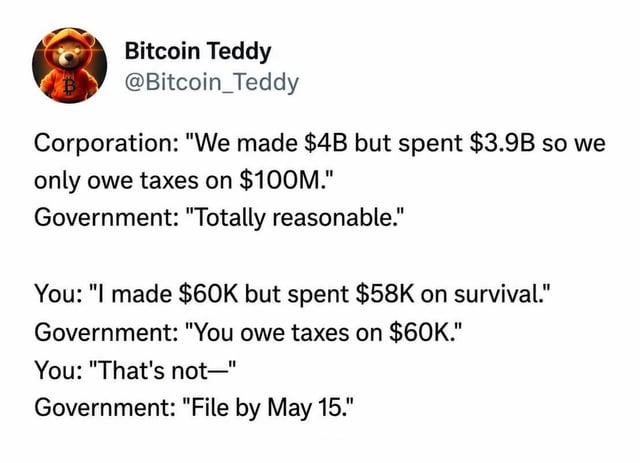
That’s the thing. Corporations report their own deductions, but individuals have to follow existing law, when there’s a high variance among necessary spending
You can also report your own deductions if you itemize. If your income is low, the standard deduction is probably just significantly bigger than your itemized deductions.
Legal deductions are extremely limited if you are an employee. You can’t deduct your car, your rent, or the big screen TV you bought.
For employers, anything that didn’t end up in the bank at the end of the year is a deduction.
You definitely want to be operating some sort of home business on the side, even if you are employed. You don’t get to count employment-related expenses, but you do get to count expenses attributable to that separate business.
Also, not true. You can deduct any expense needed for work. Uniform, supplies, food if you’re required to eat on the clock, car payments if you’re a delivery driver, all deductible. You can deduct a haircut if your employer has a grooming policy.
It’s just not worth it for most people. You need to save receipts and be able to prove it was a job-related expense, and if you do something wrong, you could be charged with tax fraud.
Commuting to and from the job is an expense needed for work. You can claim that part of your non-reimbursed travel expenses to temporary work sites that exceed your normal commute, but you can’t claim your normal commute.
You cannot deduct your commuting expenses. Not gas. Not bus fare. Not parking.
Uniform items are deductible only of you don’t get a uniform allowance.
If they give you a $50/yr boot allowance, you don’t get to claim your $300 Red Wings. If you buy your own tools but your employer provides a (shitty, shared) set, you don’t get to deduct your tools.
But, this is all about W2 employment. In practice, the overwhelming majority of expenses you incur in the process of W2 employment are not actually deductible, because your employer is already taking the deduction.
But, if you are running your own home business, your usual workplace is your home, and you can claim transportation expenses anywhere you need to go for that business. You can deduct the use of a part of your home. You can deduct part of your utilities, your wardrobe, your tools. Even if your home business is one of the 30% that are operated at a loss, you can deduct the expenses incurred while doing business, and offset a part of your W2 income.
People can report their own deductions, too. It’s just not worth it for most people.
The problem is that the IRS “doesn’t have the resources” to audit corporations and millionaires. They basically only audit small business owners.
Edit for sarcasm quotes
Even that though, you can only deduct part of your living expenses. There is no food deduction afaik, there is no deduction for insurance as far as I know.
Most of us also pay a much higher proportion of our income in sales taxes. Businesses are exempt from such taxes; they are only paid by the end user.
That’s absolutely not true. Businesses pay sales taxes, too. Nonprofits/churches/etc are exempt, but otherwise, every transaction is taxed.
No, that’s incorrect. I am very well aware of this. Businesses only have to pay sales taxes on purchases for which they are the end user. They’ll pay sales taxes on their office supplies and services provided to the business. But manufacturers do not have to pay sales taxes on the raw materials they purchase. Retailers do not pay sales taxes on wholesale purchases they make for resale. Only the end-user pays the sales tax on a purchase.
I work with a couple vendors that do not collect sales tax at all. They only sell B2B, and they only sell to businesses who provide them with a sales tax exemption certificate.
What you are describing is more akin to Europe’s VAT system. Still, under VAT, everyone in the chain pays VAT, and each vendor remits the collected VAT to the tax authority. But, the business-buyer reclaims that VAT from the tax authority if they are not the end-user of the purchased product. Everyone but the end user can reclaim their VAT payment.
Which is ass backwards. Audit those with the highest amounts and they made way more money. It’s proven it worked that way until they cut funding for it
I’m pretty sure I read that auditing the wealthy is a huge profit center for the IRS, because they find people who aren’t paying what’s owed. Naturally conservatives (of any party) hate this and gut it whenever possible
Auditing in general is profitable, but it’s mostly due to it being automated for people that aren’t making 7 figures. Auditing the not absurdly wealthy is also generally a positive revenue. Auditing the extremely wealthy tends to not be a great net benefit as the costs of lawyers and court time outweighs the settlement check at the end. There’s an argument to be made it’s worth the cost to ensure the ultra wealthy do actually pay though.
It’s billions of dollars of tax “avoidance”, cheating, and simply not paying. Unfortunately, the wealthy who are calling the shots don’t really want to pay millions for IRS lawyers
Yeah, if you look at the numbers it’s obvious. But libertarians don’t let facts get in the way of a good narrative.