First, new memory fabs start coming online in 2027, and there are more being constructed that will be coming online in subsequent years.
But, second…I think that some perspective is in order. Set new production aside. Let’s imagine a world where that didn’t happen. In fact, let’s imagine that not a single additional memory chip was going to be produced. Video games were around when I played games on an Atari 2600, to pick an early video game console. I had fun with it. It didn’t have the latest, real-time rendered photorealistic graphics. But…the Atari 2600 had 128 bytes of memory. Not gigabytes, not megabytes, not kilobytes. Bytes.
There are people building microcontrollers right now that have onboard memory, and those aren’t impacted by this. It’s just the high-density dedicated memory chips that go on DIMMs that are seeing all that demand.
According to Wikipedia, there were 30 million Atari 2600s made. The CPU I currently have in my desktop has a little over 145MB of onboard cache. Twenty-six of those CPUs, looking just at their onboard cache, no external memory from Micron/Samsung/SK Hynix, have more memory than all of the 30 million Atari 2600s ever manufactured, combined.
Like, don’t get me wrong. I enjoy using all this memory that we have had available in recent years. But…video games are here to stay and would be even if no dedicated memory chips were around.
There are three major DRAM chip manufacturers: Micron, in the US, and Samsung and SK Hynix, both in South Korea.
Micron has two new fabs coming online in Boise, Idaho. The earliest one is scheduled to start operation in the first half of 2027 (they recently announced that they’d moved that timeline up from the second half of 2027) though it’ll take time to ramp up; it will not be doing output at full capacity immediately when it first starts up.
This year, Samsung is prioritizing the conversion of its lines to memory chips at its Pyeongtaek campus in Gyeonggi and the acceleration of new facility construction at the site.
At the P4 plant, the company is upgrading dynamic random-access memory (DRAM) production to its latest 1c process, which will be used for high bandwidth memory (HBM) and advanced DRAM chips. Samsung aims to secure 1c capacity of more than 200,000 wafers per month by the end of the year through line conversion and additional equipment installation.
Construction of P5, which had previously been delayed during the semiconductor downturn, resumed this year with a timeline accelerated by roughly six months compared to earlier plans. The chipmaker is bringing in tens of thousands of new workers to construct the megafab, capable of producing HBM, DRAM, NAND flash and potentially foundry chips. Construction is expected to be completed in the first half of 2027, with equipment installation beginning shortly afterward and mass production targeted for the latter part of 2028.
Construction of the last Pyeongtaek facility, P6, is currently expected to start in the third quarter of 2028.
SK Hynix
SK hynix is currently concentrating short-term investment on expanding capacity at its M15X fab in Cheongju, North Chungcheong, while also upgrading older lines.
The company is adding 1b DRAM capacity at M15X, while accelerating 1c node conversions at its M14 and M16 fabs for production of HBM and server DRAM. After hitting a capacity of 10,000 wafers per month last year, it is expected to expand capacity by up to 70,000 wafers per month this year.
For a new greenfield project, SK hynix is advancing construction at the Yongin semiconductor cluster in Gyeonggi, one of the largest semiconductor manufacturing projects globally. The cluster will ultimately host six Samsung fabs from Samsung and four SK hynix facilities, and the latter is moving ahead first.
Construction of the first fab, Y1, is expected to be completed in February of next year, earlier than previously planned. Equipment installation is scheduled to begin in the second quarter of 2027.
Y1 will be built in six cleanroom “phases,” a unit used in fab construction for the capacity expansion stage. Each phase adds more floor space and related equipment for wafer capacity expansion. The first three phases are expected to begin operation within the same year, providing a capacity of 150,000 wafers per month, with the remaining phases adding another 150,000 wafers per month once fully operational.
The second fab in the cluster, Y2, is expected to begin construction around the third quarter of 2028.
That’s detailed!
That’s good and there are also Chinese ramping up memory production (I wish EU did something as well), but sadly it’ll still take at least a year if not more.
The interesting situation would arise if AI bubble bursts in a year leaving us with huge memory surplus. One can hope, right.


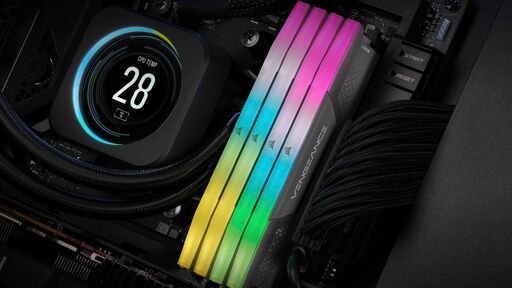
So, two points.
First, new memory fabs start coming online in 2027, and there are more being constructed that will be coming online in subsequent years.
But, second…I think that some perspective is in order. Set new production aside. Let’s imagine a world where that didn’t happen. In fact, let’s imagine that not a single additional memory chip was going to be produced. Video games were around when I played games on an Atari 2600, to pick an early video game console. I had fun with it. It didn’t have the latest, real-time rendered photorealistic graphics. But…the Atari 2600 had 128 bytes of memory. Not gigabytes, not megabytes, not kilobytes. Bytes.
There are people building microcontrollers right now that have onboard memory, and those aren’t impacted by this. It’s just the high-density dedicated memory chips that go on DIMMs that are seeing all that demand.
According to Wikipedia, there were 30 million Atari 2600s made. The CPU I currently have in my desktop has a little over 145MB of onboard cache. Twenty-six of those CPUs, looking just at their onboard cache, no external memory from Micron/Samsung/SK Hynix, have more memory than all of the 30 million Atari 2600s ever manufactured, combined.
Like, don’t get me wrong. I enjoy using all this memory that we have had available in recent years. But…video games are here to stay and would be even if no dedicated memory chips were around.
Where is this optimism coming from? China? Korea?
There are three major DRAM chip manufacturers: Micron, in the US, and Samsung and SK Hynix, both in South Korea.
Micron has two new fabs coming online in Boise, Idaho. The earliest one is scheduled to start operation in the first half of 2027 (they recently announced that they’d moved that timeline up from the second half of 2027) though it’ll take time to ramp up; it will not be doing output at full capacity immediately when it first starts up.
https://www.micron.com/us-expansion/id
They announced late last year that they were going to do a second Boise one as well for more capacity.
They also have New York fabs that they’re doing:
https://www.micron.com/us-expansion/ny
For the South Korean manufacturers:
https://koreajoongangdaily.joins.com/news/2026-03-12/business/industry/Samsung-and-SK-are-expanding-fast-but-why-is-memory-still-in-short-supply/2540153
Samsung
SK Hynix
That’s detailed! That’s good and there are also Chinese ramping up memory production (I wish EU did something as well), but sadly it’ll still take at least a year if not more. The interesting situation would arise if AI bubble bursts in a year leaving us with huge memory surplus. One can hope, right.