- cross-posted to:
- technology@lemmy.world
- cross-posted to:
- technology@lemmy.world
You must log in or register to comment.
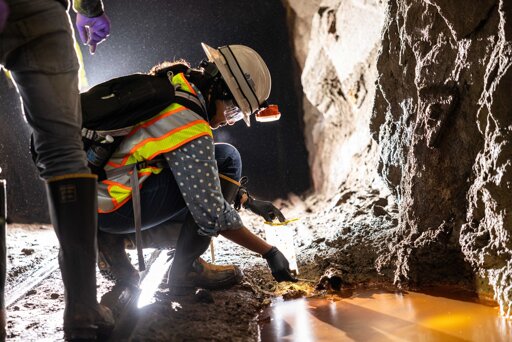
Bacteria grow on ants and fix atmospheric carbon to make a tough armor.
https://www.biorxiv.org/content/10.64898/2026.01.21.700952v1.full
Site doesnt load
That’s really cool
So reading through they think it can be used to eventually make huge filters they can use for coal plants and stuff like that.
If true this could be like whatever it was they found in Project Hail Mary that ends up saving the human race.
The thing they found in Project Hail Mary also happened to be the thing that was killing the human race.
Wait the stuff at the end?
He had a breach in his ship but fixed it and went back and saved Rocky and sent the samples of whatever it was that was eating the stuff that was destroying humans.
Spoilers:
spoiler
An interstellar microbe feeding on stars (astrophage) was the danger to humanity. They figured out it breeds on planets. But the distant planet they found had different alien microbial life that just happened to be very good at feeding on the interstellar star eaters that had chosen to breed there.
So they took samples, cultured the microbe-eating-microbes, and left to take them home. But the human guy figured out they broke containment and ate some fuel his starship uses, that Rocky’s starship happened to be made of, so he used his remaining fuel to change course and warn Rocky.
So… the CO2 eater analogy actually makes some sense. If we’re lucky this could lead to major geoengineering breakthrough, like the movie microbes did (though I wouldn’t get my hopes up).
In this case, the parasite is humanity. Or emissions-heavy industry. Or oil executives. Something like that.
Uh, that would kill amost all life on earth, if it was an excuse to keep burning coal
I sure hope so. I work in electricity generation (not coal) and I see this being potentially massive for all fuel types. Depending on if/how it can be scaled. Combined cycle was huge for emissions reduction. But this could be a completely new level if we can reduce to zero/near zero and have a useful byproduct.
Only if there’s incentive for the added cost, though. I’m skeptical such scrubbers could produce something useful enough to offset the cost by themselves.
I’d imagine if the tech gets there it will be so heavily subsidized (at least in the US) that cost won’t be a huge concern. Plus if its producing a useful biproduct that might be a decent revenue booster.
I’m glad we don’t have to worry or change anything. I was stressing there. So much relief!
“that essentially eat carbon dioxide gas (CO2) and turn it into rock at an incredibly fast rate.”
ETA to new construction method in 3-2-1…
I have a feeling “incredibly fast” is a relative term, and not a sign of this being used for construction. If they could convert it quickly enough to use for construction, wouldn’t it essentially kill off its own habitat in no time flat?
“Twenty years from now…”
So they take CO2 from the atmosphere and chemically transform it into solid materials that reduce greenhouse gasses in the atmosphere?
Congratulations you have invented plants.
Read the article. They’re hoping to mass manufacture the enzymes involved, which have the following advantages over carbon capture through plant life:
- Can work in much harsher environments, with higher operating temperatures, pressures, and acidity.
- Captures the carbon in calcium carbonate, which is more stable in retaining the carbon compared to decomposing plant matter.
- Works much faster than plants do
Sounds like you want a peat bog
Plants solid material is only temporary.
Plants eventually decompose, releasing the CO2. Rock generally doesn’t have that problem
Plants eventually decompose
On the scale of hundreds of years, thousands for some trees, tens of thousands plus if you sink fast growing trees deep in a cold sea. It is a thoroughly proven technology. If deployed at scale likely good enough to get us over the the hump to a renewables based technology without frying the Earth.
The problem is it’s not actually profitable (pretty cheap though) like the tech in OP’s article with patents and income streams (but only for fossil fuel energy generation). You’d think survival would be adequate motivation, but no.
More power to the people making this tech, everything is welcome, but if they’re going to lock it behind patents for 20 years it’s unlikely to be what is needed now.
I think microbes are probably a lot easier, faster, and more cost effective to produce compared to plants. It can survive in harsh conditions and create rock from the C02 at a fast rate according to the article.
Not only that, but they believe the active enzymes in the microbe can be optimized and engineered, then mixed into a liquid substrate. Becomes an enzyme-based CO2 filter with the byproduct of Calcium Carbonate, which can be used in concrete. The article talks about filling trucks with these and passing the emissions of coal-fired power plants through them.
Well that would be a disaster
A bigger disaster than dumping it into the atmosphere?
That would be an incredible innovation. You don’t have to stop at coal either, it’s just the dirtiest. Nat gas, trash, oil, wood and anything else burned on a huge scale could be curbed.
What about all the farting that cows do?
That’s methane. And it’s mostly from their poop, not farting.
It’s a disaster. And that industru is also a major cause of deforestation.
We have to stop buying meat.
The trouble with cow farts is the methane, a much more potent greenhouse gas that eventually turns back into CO2 in the atmosphere anyway. Concentrated methane sources tend to either be captured for use as fuel, or flared with a burning flame to reduce the greenhouse effect (at which point carbon sequestering might work). Less concentrated sources, like livestock farts, can’t really be dealr with in the same way.
Yep, you could even pepper the interstate highways of America with them and just let them passively eat the CO2 particles that cars are putting out.
Weeks instead of years. Could be big for assisting in the fight against climate change.
The downside of that kind of stuff is that you need a balance. Scrub too much CO2 and it’s trouble again.
If we can get atmospheric CO2 back down to where it was 100 years ago that would be an amazing problem to have.
Great, in 50 years we’ll be desperately switching back to fossil fuels to prevent an ice age.
I had figured space flight. Either way, I guess.
Being able to teraform is huge on earth and abroad. Cool stuff either way.
If they could create a plant that fits on a truck and can remove a ton of carbon a day then they’d have another crazy invention on their hands, this just does it and creates rock … damn.
It reminds me of Prototaxites.
I wonder if it could be feasible to take the CO2 emissions from incinerated landfill.
Empty the landfills, burn the waste, generate electricity and eat all the carbon emissions. No idea if it’s feasible in the future but it sure would be an incredible advancement.