Yeah I was memeing a bit. Their power grid is also completely fine because it’s part of the European grid that is supplied by all sorts of electricity sources that can compensate for those nuclear plants.
France exported 10TWh during July at the peak of the heatwave, their nuclear powerplants were feeding into other countries grids even during these partial shutdowns.
It shows the importance of diversifying energy production. In Quebec it’s all hydro, but sometimes the weather means the reservoirs can get low over the years. It affects production in a serious way and can take time to build up again.
Wind and solar are also affected by weather patterns in their own ways. Maybe less so or at least maybe different factors. Hedging and balancing grid production is going to be a new challenge.
Fossil fuels did have the advantage of being pretty easy to ramp up or down, whenever, for whatever reason. Some countries might want to keep around older but very efficient fossil fuel plants as backups for these kinds of events. That or waste incineration for example.
All renewables are subject to some kind of weather impacts. A challenge with the grid is adapting to spikes in demand like if it’s really cold or hot one day in particular. You cant turn up the sun or wind on demand.
We’ve been having brown outs in Canada for the first time ever in the last few years. Its crazy to imagine since our electricity is so abundant. Same with France struggling with this heat wave.
Modern Nuclear can load follow, its not as precise as peaker plants but its not too far off. Another cool thing with modern nuclear is you don’t have to directly spin the turbines some modern plants are designed to shunt thermal production to thermal batteries (large pile of salt in a tube) which can be more finely throttled allowing the exact amount of power the grid needs at any given moment to be met. They just have to throttle the reactor to keep the Salt boiling. https://www.energy.gov/ne/advanced-reactor-demonstration-projects
It’s not about whose fault it is, it is about it being a thing. The weather IS to hot for a few of their nuclear power plants since rivers run dry. That will only be getting worse in the next years.
Had the Greens across Europe not been so staunchly anti-nuclear, it wouldn’t have been a thing and we would already have been way more climate neutral. Instead they tried to jump the gun and go from worst energy generation for the planet and people to quite good without having a transitional period. They aimed for perfect and idealistic, not pragmatic and efficient.
Of course the bloody conservatives and right-wingers are the main reason we’re here, but still, going “hah, it’s the lowest carbon solution we have, but because my ideals are against it, I’ll point out the extreme situations it doesn’t work in” is still petty.


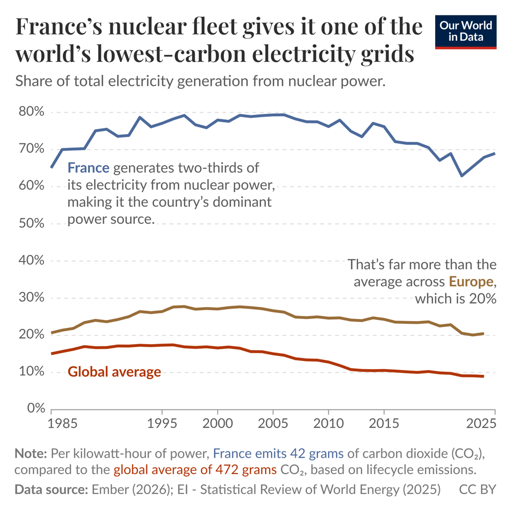
Well it also gives it a completely non-functional electrical grid because half of their nuclear power plants are shut down because of the hot weather.
Not half. “About 15%” of nuclear power plants were shut down due to water sources that were too warm for environmentally safe discharge.
https://www.reuters.com/business/energy/heatwave-expected-limit-15-frances-nuclear-fleet-friday-2026-08-13/
But that’s still a significant percentage.
Yeah I was memeing a bit. Their power grid is also completely fine because it’s part of the European grid that is supplied by all sorts of electricity sources that can compensate for those nuclear plants.
France exported 10TWh during July at the peak of the heatwave, their nuclear powerplants were feeding into other countries grids even during these partial shutdowns.
spreading disinformation, Lügenpresse
It’s not that deep lil guy
It is, your better than spreading disinformation
Completely false, at peak heat interruptions power generation is shuttered by 15%
It shows the importance of diversifying energy production. In Quebec it’s all hydro, but sometimes the weather means the reservoirs can get low over the years. It affects production in a serious way and can take time to build up again.
Wind and solar are also affected by weather patterns in their own ways. Maybe less so or at least maybe different factors. Hedging and balancing grid production is going to be a new challenge.
Fossil fuels did have the advantage of being pretty easy to ramp up or down, whenever, for whatever reason. Some countries might want to keep around older but very efficient fossil fuel plants as backups for these kinds of events. That or waste incineration for example.
Or we could ramp up renewable production in addition to nuclear and continue to diversify
All renewables are subject to some kind of weather impacts. A challenge with the grid is adapting to spikes in demand like if it’s really cold or hot one day in particular. You cant turn up the sun or wind on demand.
We’ve been having brown outs in Canada for the first time ever in the last few years. Its crazy to imagine since our electricity is so abundant. Same with France struggling with this heat wave.
Modern Nuclear can load follow, its not as precise as peaker plants but its not too far off. Another cool thing with modern nuclear is you don’t have to directly spin the turbines some modern plants are designed to shunt thermal production to thermal batteries (large pile of salt in a tube) which can be more finely throttled allowing the exact amount of power the grid needs at any given moment to be met. They just have to throttle the reactor to keep the Salt boiling. https://www.energy.gov/ne/advanced-reactor-demonstration-projects
it’s just another part of the eternal war between the french and jellyfish.
https://www.sciencealert.com/swarming-jellyfish-just-shut-down-a-nuclear-reactor-for-the-second-time
Totally the fault of France.
It’s not about whose fault it is, it is about it being a thing. The weather IS to hot for a few of their nuclear power plants since rivers run dry. That will only be getting worse in the next years.
Had the Greens across Europe not been so staunchly anti-nuclear, it wouldn’t have been a thing and we would already have been way more climate neutral. Instead they tried to jump the gun and go from worst energy generation for the planet and people to quite good without having a transitional period. They aimed for perfect and idealistic, not pragmatic and efficient.
Of course the bloody conservatives and right-wingers are the main reason we’re here, but still, going “hah, it’s the lowest carbon solution we have, but because my ideals are against it, I’ll point out the extreme situations it doesn’t work in” is still petty.