Overall, the general shape of the system makes sense.
Everybody receives services provided by the government, so everybody should help pay for that government. The FDA tests to make sure food and drugs are safe. The NHTSA makes sure cars and highways are safe. And, of course, the big one, the military protecting the country from invasion. The standard deduction exists so that people only have to start paying taxes once they get their basic needs met.
Of course, I know that in the real world it’s much more complicated than that. The US military might actually make Americans less safe by getting involved in all kinds of conflicts overseas. The terrorist attacks of Sept. 11th would probably never have attacked if the US had a defence-only military. The FDA is being corrupted by an antivax nutjob, and so-on. But, the theory of everybody contributing taxes to pay for things provided for the common good makes sense. The real standard deduction is absurdly low and almost nobody can actually fully meet their needs with that minimal amount.
It also makes sense in the abstract that corporations don’t pay taxes on money that doesn’t get distributed to the owners. If a Mom and Pop grocery store is doing really well and Mom and Pop pay themselves huge salaries, they pay personal income tax on those salaries. If they arrange to do it through corporate dividends or something, then it’s the corporation that pays taxes. On the other hand, if the store is doing really well and they want to expand, it makes sense that the government not tax them based on their revenues if they’re re-investing those revenues into the business. If they’re investing the money into making a bigger, better store to serve their community rather than simply taking the money out as profits into Mom’s purse and Pop’s wallet that’s good for the community. Also, if Mom and Pop made $400k in revenue but spent $390k on expenses, and that includes the wages of some cashiers, it’s probably unreasonable to tax the revenue before the employees are even paid.
The problem is really in the various loopholes and ways corporations claim to be re-investing the money. We wouldn’t want Mom and Pop’s grocery store to be unable to expand because they’re taxed before they can even invest. On the other hand if Pop buys a Porsche SUV under the store’s name and claims it’s a grocery delivery van, that’s not fair. Other people have to buy their SUVs with after-tax money. In theory, if Pop is caught claiming that SUV as a business expense but using it for purely personal purposes, the IRS will go after him. But, of course, the reality is that companies get away with that kind of thing all the time.
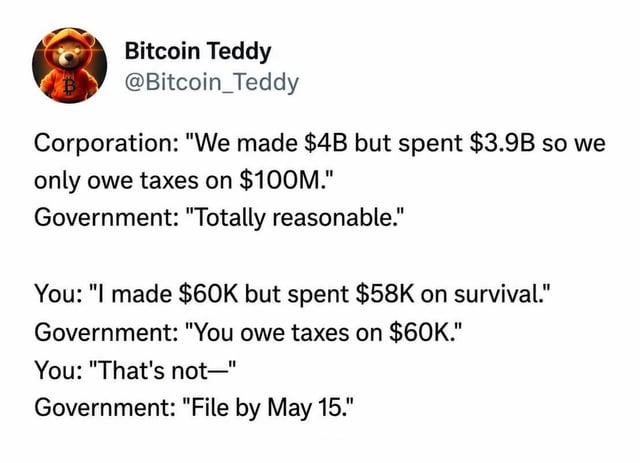
I think part of the complaint here is based in the reality that corporations get away with lots of things, and that taxes are a real burden on the poor and middle class. On the other hand, I think there’s also a lot of financial illiteracy where people really have no idea how the taxation system works. They just see ragebait on social media and get angry because something about it seems unfair.


Overall, the general shape of the system makes sense.
Everybody receives services provided by the government, so everybody should help pay for that government. The FDA tests to make sure food and drugs are safe. The NHTSA makes sure cars and highways are safe. And, of course, the big one, the military protecting the country from invasion. The standard deduction exists so that people only have to start paying taxes once they get their basic needs met.
Of course, I know that in the real world it’s much more complicated than that. The US military might actually make Americans less safe by getting involved in all kinds of conflicts overseas. The terrorist attacks of Sept. 11th would probably never have attacked if the US had a defence-only military. The FDA is being corrupted by an antivax nutjob, and so-on. But, the theory of everybody contributing taxes to pay for things provided for the common good makes sense. The real standard deduction is absurdly low and almost nobody can actually fully meet their needs with that minimal amount.
It also makes sense in the abstract that corporations don’t pay taxes on money that doesn’t get distributed to the owners. If a Mom and Pop grocery store is doing really well and Mom and Pop pay themselves huge salaries, they pay personal income tax on those salaries. If they arrange to do it through corporate dividends or something, then it’s the corporation that pays taxes. On the other hand, if the store is doing really well and they want to expand, it makes sense that the government not tax them based on their revenues if they’re re-investing those revenues into the business. If they’re investing the money into making a bigger, better store to serve their community rather than simply taking the money out as profits into Mom’s purse and Pop’s wallet that’s good for the community. Also, if Mom and Pop made $400k in revenue but spent $390k on expenses, and that includes the wages of some cashiers, it’s probably unreasonable to tax the revenue before the employees are even paid.
The problem is really in the various loopholes and ways corporations claim to be re-investing the money. We wouldn’t want Mom and Pop’s grocery store to be unable to expand because they’re taxed before they can even invest. On the other hand if Pop buys a Porsche SUV under the store’s name and claims it’s a grocery delivery van, that’s not fair. Other people have to buy their SUVs with after-tax money. In theory, if Pop is caught claiming that SUV as a business expense but using it for purely personal purposes, the IRS will go after him. But, of course, the reality is that companies get away with that kind of thing all the time.
I think part of the complaint here is based in the reality that corporations get away with lots of things, and that taxes are a real burden on the poor and middle class. On the other hand, I think there’s also a lot of financial illiteracy where people really have no idea how the taxation system works. They just see ragebait on social media and get angry because something about it seems unfair.