I totally get what you’re saying… but to be fair if you did allow people to deduct all the money they spent in a year from their income, it would specifically encourage a lot of people to spend every single dollar they earned just to avoid the taxes.
They’d be like “hang on, if I spend $3000 a month on rent I get taxed on the $1000 I have left over? What if I move to a place that costs $4000 a month? No taxes? That’s what I’ve got to do then!”
Is that sensible? No. The tax they’d pay on the $1000 is way less than the extra $1000 they’re planning on spending to avoid it, but people seem to have a real aversion to a little tax, and many would feel they “got something” for the extra money they spent on groceries or restaurants or rent, compared to the taxes which are simply taken from them.
I’m not saying it couldn’t work, I’m not saying there aren’t better ways to do it, and I’m definitely not saying there aren’t weird cliffs in programs like this that lock people into poverty. But I’d be worried that people who are already wrong about graduated tax brackets, for example, would make a lot dumber choices if they felt they could spend $40 on fancier bread to avoid “$40 of taxes”
It makes plenty of sense for them to not be taxed on their gross revenue.
You’re thinking of this from a mega-corp standpoint when you should be thinking of this from a small business standpoint. Mega-corps really should be forced to abide by different rules, in my opinion.
Let’s imagine you own a bakery shop and it brought in $1,000,000 in revenue this year. You spent $400,000 on raw ingredients, $250,000 on salaries and personnel, and $150,000 on maintenance and equipment…etc
At the end of the year, your business would go bankrupt if it was expected to pay taxes on that million dollars, despite your operating expenditures eating up the grand majority of your year. Similarly, every dollar you spend and every dollar that is spent on wages or salaries is taxed anyways, first or second hand.
That’s why that exists.
It makes sense for small or even large businesses.
Where the whole thing breaks down is when you have mega corporations like we do today. Who have accumulated wealth, power, and influence well beyond the scope of what any of these laws and regulations were meant to handle
Sorta, but despite what some governments have decided, corporations typically aren’t people. Most companies don’t want to accumulate savings, the way humans do. Profit is cool, for sure, but companies don’t save up for retirement, or go on vacations, or have kids. So some buffer to survive a less profitable year, or a costly watermain break or something, is prudent but that’s where it might end.
Anything more than that, and maybe you hire some new staff, in which case that expense to you becomes income for your new employee, which they pay income tax on. Or you buy more merchandise, which the government may collect sales tax on. Or you may expand your office, and the government collects tax from the construction company and property tax on the new unit. Or you may offer a bonus to your existing employees, which is again income tax for them. Or you could issue dividends to shareholders, which they’re taxed on when they receive them.
So the logic is that the things a company spends its money on are taxed in different ways, and the corporate income tax is basically the catch-all for “and then the rest of the money you didn’t spend some other way”
Now, do we lowly humans typically get double-dipped when we have our income taxed, but then after that also sales tax when we buy stuff? Yes. Yes we do…
Now if Company A owns Company B did it really lose 1k?
This is how money laundering works. More money more problems. You just have to leave a convincing paper trail an accountant will follow. Eventually they won’t be able to follow that the flour supplier Company Z that Company B buys from for it’s cookies is funneling Company B’s money back into Company A. The accountant doesn’t know that B isn’t buying flour or making cookies. Sometimes they even make cookies…
That’s not money laundering, though. That’s just normal fucking loophole and corruption in our tax system that only the larger players get to really benefit from, while all the small players, a.k.a. all your local businesses or even regional businesses, usually aren’t large enough to take advantage of that sort of thing.
Business spent 3.9B dollars on vaporware. That’s the problem. Or stock buybacks. Or settlements or CEO bonuses. Not on better wages or anything opex related. Basic capex to keep things up to code/inspection/regulation/etc.
It’s where the money is going that makes it a scam.
Does that include your local or regional convenience store or your local bakery or any of your local businesses as well, who would most definitely go out of business and go bankrupt because the grand majority of the revenue is spent in operating expenses.
I’m sure a ton of megacorps would love to buy up a bunch of new failing small businesses to enshitify and roll them into everything that you already hate. Funnelling money out of your local communities, making your local communities even poorer than they already are
Cut CEO and upper management wages then. Those taxes should be guaranteed to the country and should have been there from the start. There wouldn’t be any national debt and publicly funded projects wouldn’t be starving like they are now. Hell, even income tax could be wiped away from the money they’d pull in from taxes.
If in the US, a corporation is technically a person, they should also be taxed like any other person.
The grand majority of businesses are smaller, medium-sized businesses, not huge corps that have golden parachute CEOs.
So, by doing this, all you would do is kill all your local businesses, and the large megacorps that you hate would happily swoop in and gobble them up and consolidate them and then enshitify them.
This would be like shooting yourself in the liver to spite your enemy.
Second-order effects are a thing. Laws and regulations need to target these large corporations who are abusing the tax system.
They make older people spend all their money to get long term care with Medicare.
Nursing home care is incredibly expensive but Medicare will only help you pay for it if you get rid of all your income and assets until you get to their cutoff limit before they’ll help you pay for it.
There is a whole industry built in helping older people spend their money so they can get health care.
This. They may also make you sell your house too. I spoke to a family who was trying to get a loved one in a nursing home and they said they were quoted something like 20,000/mo. I asked if they meant per year and they reiterated that it was per month. All that money for a place that will let you stew in your own feces…
People have a real aversion to a little tax because right now in many (all?) places it means “money I earned through hard work is going to fund some rich asshole’s party, safe some breadcrumbs that somehow made their way into funding something beneficial to me or other folks like me”. With this fixed, at least I will have no problems with taxes


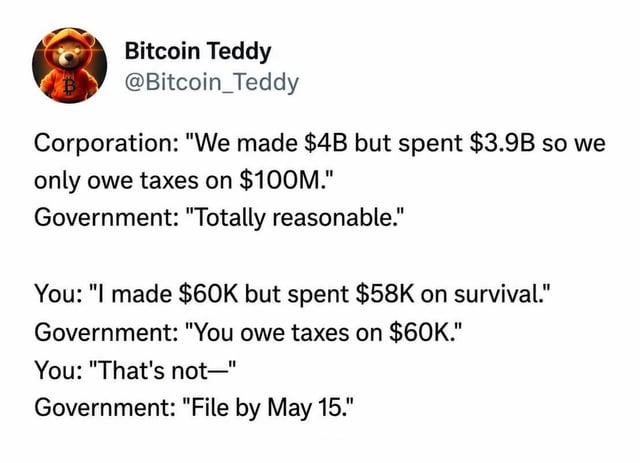
I totally get what you’re saying… but to be fair if you did allow people to deduct all the money they spent in a year from their income, it would specifically encourage a lot of people to spend every single dollar they earned just to avoid the taxes.
They’d be like “hang on, if I spend $3000 a month on rent I get taxed on the $1000 I have left over? What if I move to a place that costs $4000 a month? No taxes? That’s what I’ve got to do then!”
Is that sensible? No. The tax they’d pay on the $1000 is way less than the extra $1000 they’re planning on spending to avoid it, but people seem to have a real aversion to a little tax, and many would feel they “got something” for the extra money they spent on groceries or restaurants or rent, compared to the taxes which are simply taken from them.
I’m not saying it couldn’t work, I’m not saying there aren’t better ways to do it, and I’m definitely not saying there aren’t weird cliffs in programs like this that lock people into poverty. But I’d be worried that people who are already wrong about graduated tax brackets, for example, would make a lot dumber choices if they felt they could spend $40 on fancier bread to avoid “$40 of taxes”
This just sounds to me like a strong argument for not letting corporations deduct expenditures from taxable revenue.
Holy shit what are these AI-ass essay length replies, tax corporations more you fucking squares.
It makes plenty of sense for them to not be taxed on their gross revenue.
You’re thinking of this from a mega-corp standpoint when you should be thinking of this from a small business standpoint. Mega-corps really should be forced to abide by different rules, in my opinion.
Let’s imagine you own a bakery shop and it brought in $1,000,000 in revenue this year. You spent $400,000 on raw ingredients, $250,000 on salaries and personnel, and $150,000 on maintenance and equipment…etc
At the end of the year, your business would go bankrupt if it was expected to pay taxes on that million dollars, despite your operating expenditures eating up the grand majority of your year. Similarly, every dollar you spend and every dollar that is spent on wages or salaries is taxed anyways, first or second hand.
That’s why that exists.
It makes sense for small or even large businesses.
Where the whole thing breaks down is when you have mega corporations like we do today. Who have accumulated wealth, power, and influence well beyond the scope of what any of these laws and regulations were meant to handle
Sorta, but despite what some governments have decided, corporations typically aren’t people. Most companies don’t want to accumulate savings, the way humans do. Profit is cool, for sure, but companies don’t save up for retirement, or go on vacations, or have kids. So some buffer to survive a less profitable year, or a costly watermain break or something, is prudent but that’s where it might end.
Anything more than that, and maybe you hire some new staff, in which case that expense to you becomes income for your new employee, which they pay income tax on. Or you buy more merchandise, which the government may collect sales tax on. Or you may expand your office, and the government collects tax from the construction company and property tax on the new unit. Or you may offer a bonus to your existing employees, which is again income tax for them. Or you could issue dividends to shareholders, which they’re taxed on when they receive them.
So the logic is that the things a company spends its money on are taxed in different ways, and the corporate income tax is basically the catch-all for “and then the rest of the money you didn’t spend some other way”
Now, do we lowly humans typically get double-dipped when we have our income taxed, but then after that also sales tax when we buy stuff? Yes. Yes we do…
Isn’t this what business do to avoid paying taxes also?
nO YoU dONt unDErsTAnD iTS a ComPAnY iT sHOuldNT pAy TaXEs!!!
Yes.
Company A gets 1k. 1k is revenue.
Company A spends 1K at Company B. 1k is expense.
Company A has made 0 profit. 0 taxes.
Now if Company A owns Company B did it really lose 1k?
This is how money laundering works. More money more problems. You just have to leave a convincing paper trail an accountant will follow. Eventually they won’t be able to follow that the flour supplier Company Z that Company B buys from for it’s cookies is funneling Company B’s money back into Company A. The accountant doesn’t know that B isn’t buying flour or making cookies. Sometimes they even make cookies…
That’s not money laundering, though. That’s just normal fucking loophole and corruption in our tax system that only the larger players get to really benefit from, while all the small players, a.k.a. all your local businesses or even regional businesses, usually aren’t large enough to take advantage of that sort of thing.
deleted by creator
Or, hear me out, corporations pay taxes on their total income as well.
Business spent 3.9B dollars on vaporware. That’s the problem. Or stock buybacks. Or settlements or CEO bonuses. Not on better wages or anything opex related. Basic capex to keep things up to code/inspection/regulation/etc.
It’s where the money is going that makes it a scam.
Does that include your local or regional convenience store or your local bakery or any of your local businesses as well, who would most definitely go out of business and go bankrupt because the grand majority of the revenue is spent in operating expenses.
I’m sure a ton of megacorps would love to buy up a bunch of new failing small businesses to enshitify and roll them into everything that you already hate. Funnelling money out of your local communities, making your local communities even poorer than they already are
No business would survive without doubling or tripling their profit margins, and we’d all suffer insanely high prices
What do you think all that tax revenue is for?
A corporate environment without wiggle room for excess would also shake out a lot of grifters.
Cut CEO and upper management wages then. Those taxes should be guaranteed to the country and should have been there from the start. There wouldn’t be any national debt and publicly funded projects wouldn’t be starving like they are now. Hell, even income tax could be wiped away from the money they’d pull in from taxes.
If in the US, a corporation is technically a person, they should also be taxed like any other person.
The grand majority of businesses are smaller, medium-sized businesses, not huge corps that have golden parachute CEOs.
So, by doing this, all you would do is kill all your local businesses, and the large megacorps that you hate would happily swoop in and gobble them up and consolidate them and then enshitify them.
This would be like shooting yourself in the liver to spite your enemy.
Second-order effects are a thing. Laws and regulations need to target these large corporations who are abusing the tax system.
Wouldn’t spending every last dollar result is more sales tax?
They make older people spend all their money to get long term care with Medicare.
Nursing home care is incredibly expensive but Medicare will only help you pay for it if you get rid of all your income and assets until you get to their cutoff limit before they’ll help you pay for it.
There is a whole industry built in helping older people spend their money so they can get health care.
This. They may also make you sell your house too. I spoke to a family who was trying to get a loved one in a nursing home and they said they were quoted something like 20,000/mo. I asked if they meant per year and they reiterated that it was per month. All that money for a place that will let you stew in your own feces…
People have a real aversion to a little tax because right now in many (all?) places it means “money I earned through hard work is going to fund some rich asshole’s party, safe some breadcrumbs that somehow made their way into funding something beneficial to me or other folks like me”. With this fixed, at least I will have no problems with taxes