

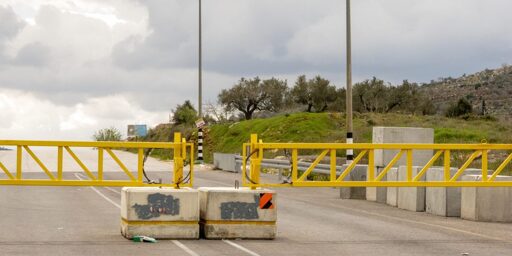
Traffic was at a standstill outside of Nablus in the occupied West Bank on Saturday, as sunset neared and hungry residents were forced to trickle through an Israeli checkpoint to get home and break their fasts.
The Israeli military had sealed the city off from the outside world. Just over a week after the U.S. and Israel launched their joint war on Iran, Israeli settlers have ramped up their violence against Palestinians in the West Bank, and Israeli forces have imposed a near-total closure of municipal centers, shutting gates and restricting crossings without warning or perceptible logic.
“This is not something new. It happened in June during the Twelve Day War, and it’s kicking off again,” Tatarsky said. “But what’s different this time is that Israel is also blocking roads — not only disconnecting Palestinians from Area C, but also blocking roads between Palestinian villages.”
A week later, on March 7, there was still only one checkpoint out of Ramallah open, forcing all traffic through a bottleneck that passes by the Beit El settlement and through the Jalazone refugee camp. This is the only route for Palestinians living in Ramallah to access Route 60, the main thoroughfare connecting Palestinian communities in the south to those in the north.
WAFA, the Palestinian Authority’s news agency, estimates that settler attacks have increased 25 percent since the start of the conflict. Israeli settlers have killed six Palestinians since the start of the war with Iran, including three in one incident in the West Bank community of Khirbet Abu Falah, east of Ramallah.
Israeli settlers shot Fare’ Hamayel and Thaer Hamayel, and a third man, Mohammad Murra, died of suffocation from tear gas deployed by Israeli forces.
As the world’s attention remains on Iran, solidarity activists said that Israeli settlers appear to feel they have additional impunity to conduct attacks.
“They will be treated as heroes by their supporters, by their society,” Etkes said. “And the government will do nothing about it.”